
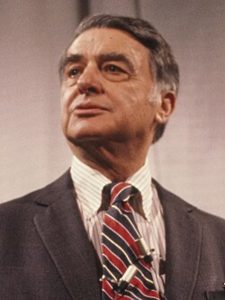
(Photo source: Wikipedia, Bernard Gotfryd photographer)
Edwin Land was one of the most influential inventors and entrepreneurs of the 20th century, best known for revolutionizing photography through instant imaging. He was born on May 7, 1909, to a Jewish family of Ukrainian background in Bridgeport, Connecticut. He developed an interest in optics as a teenager and briefly attended Harvard University to study physics and optics. However, he left before completing his degree to pursue his goal of developing a polarizing filter.
He was successful and in 1932 he set up the Land-Wheelwright Laboratories with his Harvard physics professor to commercialize his polarizing technology. The company was renamed the Polaroid Corporation in 1937, and they initially focused on producing polarized sunglasses and optical devices, although his invention was also critical for the subsequent development of liquid crystal displays. His inexpensive polarizing filters had immediate practical applications, from reducing glare in car headlights to improving military optics during World War II. These early successes established Land as both a brilliant scientist and a capable businessman.
His most famous achievement came in 1947 when he demonstrated the first instant photography system. Legend has it that the idea was sparked by a question from his young daughter, who asked why she couldn’t see a photograph immediately after it was taken. Inspired by his daughter, Land developed a camera and film system that allowed users to see fully developed photos within minutes. This innovation led to the release of the first commercial instant camera, the Polaroid Land Camera, in 1948. The product was a massive success and transformed amateur photography, making it more accessible and interactive.
He was notorious for his marathon research sessions. Once an idea gripped him, he could work on the problem until it was solved, often days at a time, without any kind of break. He needed food to be brought to him and reminded to eat. His staff could not keep up with his efforts, so they assisted him as teams working in shifts.
Land was a named inventor on over 500 patents, making him one of the most prolific inventors in history. His work extended beyond photography into areas such as color vision and image processing. He developed the Retinex theory of color vision, which explained how humans perceive color consistently under varying lighting conditions. This theory later influenced digital imaging and computer vision technologies.
In addition to running Polaroid Corp., Land was a dedicated public servant. He was involved in the design of the optical systems used in the U-2 program, various photographic satellites and the Manned Orbiting Laboratory. He also sat on the President’s Science Advisory committee, the President’s Foreign Intelligence Advisory Board and the National Commission on Technology, Automation and Economic Progress.
Land was recognized by many professional organizations for his technical achievements, including the American Academy of Arts and Sciences, the American Philosophical Society, the Optical Society of America, the National Academy of Sciences, the National Academy of Engineering and the Physical Society (U.K.). He was also the recipient of several awards, not the least of which was the Presidential Medal of Freedom. And, in 1957, he eventually received his Harvard doctorate, one of more than ten honorary degrees he was awarded.
Land died in 1991, but his legacy endures. His inventions not only transformed photography but also influenced fields ranging from optics to digital imaging. His ability to merge scientific insight with practical application made him a pioneer whose impact continues to be felt in modern technology.
Author: Iain A. McIntyre