
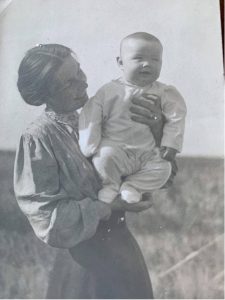
Photo credit: According to the Canadian Encyclopedia, the photo is found in a book titled How to Become an Accidental Genius (2019) by Frieda Wishinsky and Elizabeth MacLeod (Courtesy Julie Shepard).
Olivia Poole, an Indigenous Canadian inventor, pulled from her childhood memories on the White Earth Indian Reservation to invent the Jolly Jumper, making the lives of parents everywhere easier and becoming one of the first Indigenous women in Canada to patent an invention.
Olivia Poole (nee Susan Olivia Davis) was born in 1889 in Devil’s Lake, North Dakota and grew up in Minnesota on the White Earth Indian Reservation. While living on the Reservation, Poole, who was part Ojibwe or Chippewa, became familiar with the tribal custom of cradleboards that gave mothers greater freedom to work. Mothers would hang cradleboards, which the Ojibwe people call dikinaagan, on a tree branch as a swing or hammock. The mothers would pull the branch or the ropes suspending the cradleboard to bounce the baby. The babies were entertained and soothed by the bouncing motion and mothers were able to work freely.
Poole attended Brandon College in Manitoba, Canada to study music. In Manitoba, Poole met her husband Delbert, and the couple had seven children together. In 1910, after Poole’s had her first baby Joseph, she remembered the cradleboards of the White Earth Indian Reservation. However, Poole did not have access to one in Ontario, where she was living in 1910.
Poole decided to make her own cradleboard using objects from around her house. Using a cloth diaper as a harness and a broom handle for a suspension bar, Poole built the first prototype of a baby jumper, which she called the Jolly Jumper. Later she added a spring and rubber connection. The swing and spring combination allowed the baby to bounce on its own, without the caregiver needing to pull on the straps. The Jolly Jumper differed from cradleboards as the baby’s legs dangled freely, sinking low enough to touch the ground and jump back up, and the Jolly Jumper had no attached board.
Poole used the Jolly Jumper with all her children and then her grandchildren. Over time, Poole was able to make improvements to the original design. In 1948, Poole’s family members convinced her that she should commercialize the jumper, given its success within the family. The Jolly Jumper went into mass production for retail in the early 1950s. With the help of her eldest child, Joseph, Poole applied for a patent in 1957 with the invention title “Baby Supporter and Exerciser” (CA Pat. No. 568,775). Poole and Joseph created Poole Manufacturing Co., Ltd. in British Columbia to manufacture and sell Jolly Jumpers worldwide.
Poole died in 1975 from pneumonia complications. Jolly Jumpers are still being sold today and remain a popular baby item.
Author: Charlotte Lucas